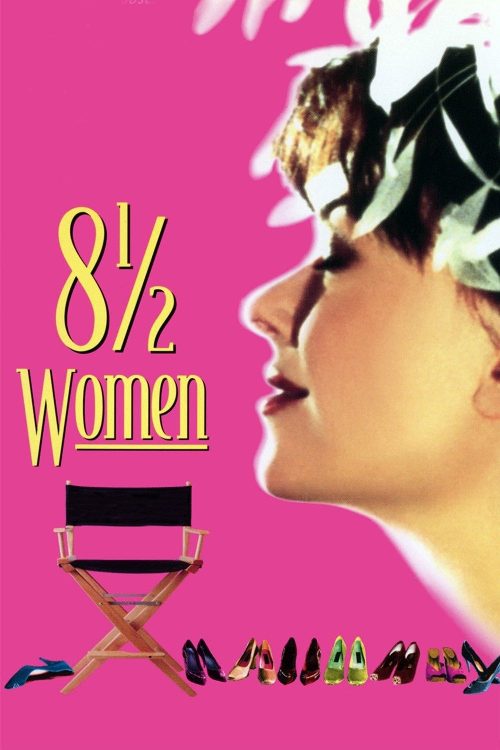
About 8 ½ Women
After his wife dies, middle-aged businessman Philip Emmenthal, at the prompting of his playboy son Storey, populates his Geneva villa with eight-and-a-half concubines. Three are from Kyoto, where Storey manages Pachinco palaces. Each has a distinctive personality: a nun, a child bearer, a gambler, a student of Kabuki, a horsewoman with a pet pig, a maid. As a year passes, the women begin asserting their own power.
Peter Greenaway has long been a provocateur of the silver screen, and 8 1/2 Women stands as one of his most visually opulent yet intellectually thorny inquiries into the human condition. While contemporary Indian cinema often navigates the complexities of domestic duty and societal patriarchies, this 1999 feature offers a starkly different, European-centric exploration of control and desire. The story follows a wealthy widower and his son who decide to transform their lavish Swiss estate into a private sanctuary populated by a curated collection of women from diverse backgrounds. What begins as an exercise in male fantasy and architectural precision quickly spirals into a meditation on the futility of trying to commodify human relationships. It is a film that functions less like a conventional narrative and more like a gallery installation, where the framing of each shot is just as important as the dialogue.
For viewers accustomed to the emotional resonance found in the best of Telugu or Hindi dramas, this film might feel cold or overtly stylized, yet its thematic focus on the dynamics of power remains universal. Greenaway utilizes a global cast to emphasize the absurdity of the protagonists attempt to manage their own personal harem. As the residents of the villa begin to reclaim their agency, the film subtly shifts from a comedy of manners into a critique of the very obsession that sparked the premise. It is a challenging watch that prioritizes aesthetic arrangement and philosophical posturing over traditional character arcs, making it an ideal choice for cinephiles who appreciate the auteur-driven eccentricity of late nineties art house cinema.
The inclusion of international performers like Toni Collette and John Standing highlights the directors ambition to blend different acting styles within a highly controlled environment. In the context of modern global cinema, where audience tastes are increasingly shifting toward high-concept narratives, this film serves as a reminder of the experimental spirit that defined a generation of independent directors. It is not necessarily for the casual viewer seeking a straightforward story, but rather for those who are intrigued by the intersection of wealth, isolation, and the inherent volatility of personal relationships. By dissecting the intersection of privilege and objectification, the film leaves its audience to ponder whether the captors are actually the ones trapped in their own decadent design. This remains a singular entry in the directors body of work, functioning as both a visual feast and a cynical reflection on the art of possession.
Cast(50)