About Back to the Primitive
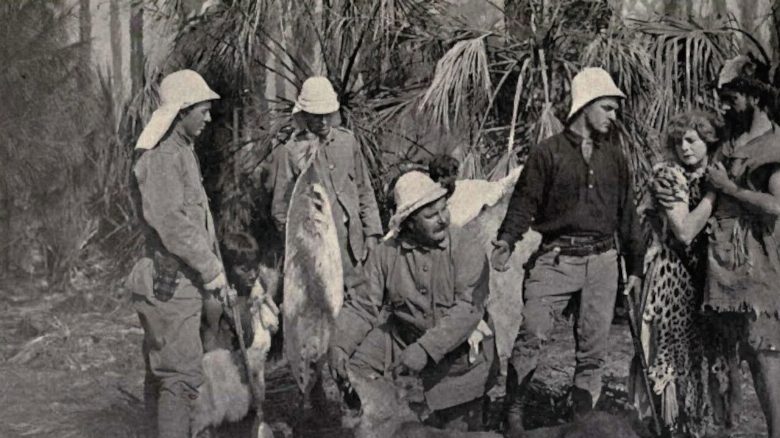
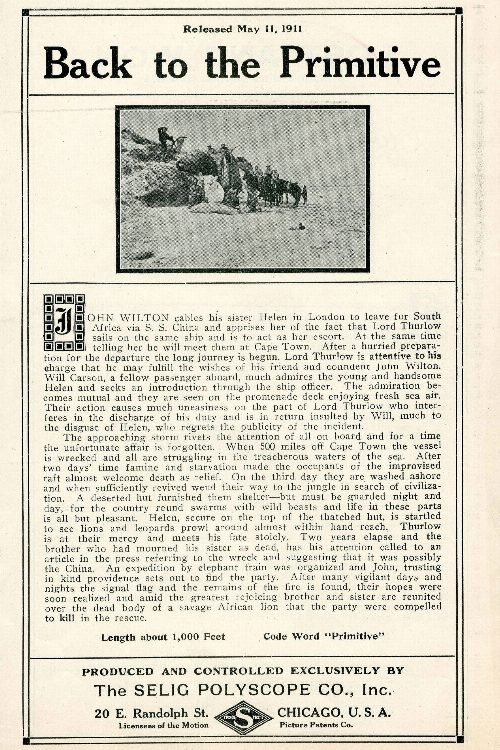
John Wilton cables his sister Helen in London to leave for South Africa via S.S. China and apprises her of the fact that Lord Thurlow sails on the same ship and is to act as her escort. At the same time telling her he will meet them at Cape Town. After a hurried preparation for the departure the long journey is begun. Lord Thurlow is attentive to his charge that he may fulfill the wishes of his friend and confidant, John Wilton. Will Carson, a fellow passenger aboard, much admires the young and handsome Helen and seeks an introduction through the ship officer. The admiration becomes mutual and they are seen on the promenade deck enjoying fresh sea air. Their action causes much uneasiness on the part of Lord Thurlow, who interferes in the discharge of his duty, and is in turn insulted by Will, much to the disgust of Helen, who regrets the publicity of the incident. The approaching storm rivets the attention of all on board and for a time the unfortunate affair is forgotten.
When early cinema captured the raw tension between social propriety and the untamed force of nature, Back to the Primitive emerged as a compelling relic of the silent era. Directed by Otis Turner in 1911, this adventure drama transports audiences to the high seas, setting the stage for a classic collision of Victorian etiquette and sudden, chaotic peril. The film thrives on the friction between a carefully orchestrated chaperoned journey and the unpredictable whims of a budding romance, all placed against the backdrop of a maritime voyage that promises far more than just a change in latitude. By focusing on the interplay between the sheltered Helen and the charismatic Will Carson, the narrative taps into the foundational tropes of early twentieth-century storytelling, where human resolve is tested not just by interpersonal conflict but by the looming, indifferent power of the ocean.
For students of film history, this production serves as a fascinating snapshot of how the industry once utilized limited space and time to build palpable stakes. The presence of Tom Mix, a name synonymous with the evolution of the action genre, adds a layer of historical significance to the project. While modern viewers accustomed to the high-octane pacing of contemporary Indian cinema or the sprawling epics of Tollywood and Bollywood might find the rhythmic structure of this silent short quite distinct, there is a shared DNA here regarding the portrayal of moral duty versus personal desire. The film operates on a level of theatricality that requires the audience to pay close attention to gesture and expression, offering a masterclass in visual communication that predates the reliance on heavy dialogue.
Those who appreciate the roots of the adventure genre will find this piece particularly rewarding as a study of character archetypes. It captures a moment in time when the screen was beginning to move beyond mere documentation toward complex, albeit contained, narratives. It is an ideal watch for those curious about the transition period of cinema, where the focus shifted from simple spectacle to the psychological drama of people trapped within a small, moving vessel. As Lord Thurlow attempts to maintain the rigid standards of his class while a storm brews on the horizon, the film invites viewers to reflect on how quickly civilization can be stripped away by the elements. It remains a quintessential example of how the medium of film began to explore the fragility of human constructs when confronted with the vast, unknown world.
Cast(2)

Crew
Director
Similar Films