
Birth of a Nation(2025)
About Birth of a Nation
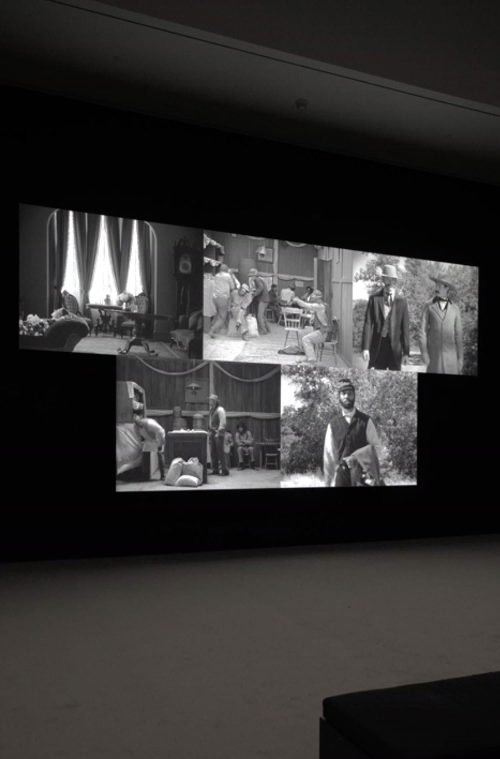
Birth of a Nation reinterprets D.W. Griffith's notorious 1915 film The Birth of a Nation, a technically groundbreaking but deeply racist work that glorifies white supremacy and the Ku Klux Klan. Stan Douglas focuses on one infamous narrative strand from Griffith’s film involving the character Gus—a Black man played in blackface—who is falsely depicted as a threat to a white woman, Flora. In the original, this leads to her death and Gus's lynching by the Klan.
Cinema has long grappled with the poisonous legacy of its most controversial artifacts, yet few filmmakers possess the audacity to dismantle a foundational piece of American propaganda like Stan Douglas. With his 2025 project Birth of a Nation, the acclaimed visual artist and director steers the lens away from the toxic mythology of the 1915 original to interrogate the specific, dehumanizing tropes that have haunted global storytelling for over a century. Instead of a standard remake, this work functions as a rigorous cinematic autopsy, isolating the exploitative narrative of the character Gus to expose how early motion pictures weaponized fiction to cement systemic oppression. By centering the human cost behind these static, racist archetypes, Douglas challenges the audience to confront how historical visual languages continue to shape modern perceptions of justice and identity.
For viewers who appreciate the intersection of high-concept art and political discourse, this film offers a profound intellectual experience that resonates well beyond the borders of Hollywood. While the South Indian and broader Indian film industries have recently focused on reclaiming historical narratives through grand spectacles and mythological reinterpretations, Birth of a Nation provides a stark, minimalist contrast, emphasizing archival precision over epic artifice. It is a vital watch for those interested in the ethics of representation and the evolution of film theory. By stripping away the celebratory gloss of the silent era, the production forces a dialogue about the responsibility of the creator when engaging with the ghosts of the past.
The cast, featuring Francis Faye and Terrance Livingston Jr., navigates these heavy thematic waters with a measured intensity that avoids the trap of melodrama. Their performances serve as the emotional anchor in a film that is fundamentally concerned with the mechanics of erasure and historical accountability. Given Douglas’s history of utilizing multi-media installations to dissect urban history and social memory, this latest venture feels like an inevitable evolution of his craft. It is positioned not merely as a historical critique, but as a necessary confrontation with the foundational sins of the medium. For the cinephile seeking a film that demands active engagement and critical reflection, this work stands as one of the most provocative cinematic statements of the year, proving that the most powerful way to rewrite history is to look directly into its darkest corners and refuse to blink.