

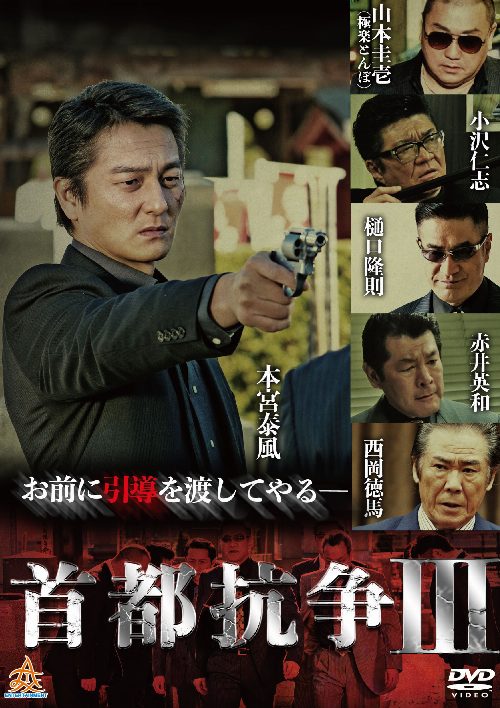
Capital Conflict 3(2017)
About Capital Conflict 3
To prevent the Kansai-based Tenma-kai from expanding into Kanto, Enomoto (Yasukaze Motomiya), leader of the Enomoto-gumi and part of the Kanto yakuza, was guarding Takeda Masaki (Tokuma Nishioka), president of the largest Kanto organization, the Bandō Alliance. However, Takeda was targeted by a hitman. Although Takeda survived, he remained unconscious, and his condition was critical. Makabe (Takanori Higuchi), the director of the organization, plotted to take over as Takeda’s successor and support the Tenma-kai’s advance into Kanto. Learning of Makabe’s schemes, Enomoto ordered Higuchi (Keiichi Yamamoto), the underboss, to investigate his movements. Meanwhile, Takeda regained consciousness and, from his hospital bed, announced his retirement. He expressed his intent to name Makabe as his successor, shocking both Enomoto and Makabe. However, this decision came with a specific condition...
Within the landscape of modern Japanese crime cinema, the third installment of the Capital Conflict series serves as a masterclass in the intricate power dynamics that define the yakuza genre. Director Katsuji Kanazawa leans heavily into the claustrophobic tension of internal betrayal, moving away from the sprawling street battles often seen in contemporary action films to focus on the cold, calculated maneuvering of boardroom-style intimidation. By grounding the narrative in the fragile hierarchy of the Bando Alliance, the film captures the existential dread of an underworld organization facing a leadership crisis, making it a compelling watch for those who appreciate the strategic, dialogue-heavy political dramas that occasionally surface in the V-cinema tradition.
The story centers on a pivotal power vacuum created when the head of the Kanto-based syndicate falls victim to a targeted attack, leaving his subordinates to grapple with the looming threat of an encroaching Kansai rival. The film distinguishes itself by highlighting the moral ambiguity of its characters, particularly through the eyes of Enomoto, played by Yasukaze Motomiya. As a loyalist caught between preserving an old guard and navigating the opportunistic schemes of ambitious rivals like Makabe, Motomiya delivers a performance of stoic intensity that grounds the more volatile elements of the plot. The unexpected twist regarding the succession plan injects a layer of psychological complexity into the proceedings, forcing the audience to question whether the leader is playing a grand game of chess or if he has truly surrendered to the inevitable changes in the criminal landscape.
For viewers who follow the trajectory of Japanese genre cinema, Capital Conflict 3 stands as a significant entry because it prioritizes character nuance over gratuitous spectacle. While it occupies a niche space within the global market, its themes of loyalty, betrayal, and the shifting nature of authority resonate with fans of high-stakes crime thrillers regardless of cultural background. It is a film for the patient viewer who enjoys seeing a story unfold through whispers in backrooms and the subtle shifts in facial expressions during high-pressure negotiations. By focusing on the internal rot of a powerful organization rather than just the external threats posed by rival syndicates, Kanazawa ensures the film remains a sharp, sophisticated exploration of power. It serves as a reminder that in the world of the yakuza, the most dangerous weapon is not a blade or a firearm, but a well-timed decision that can dismantle a legacy from within.



