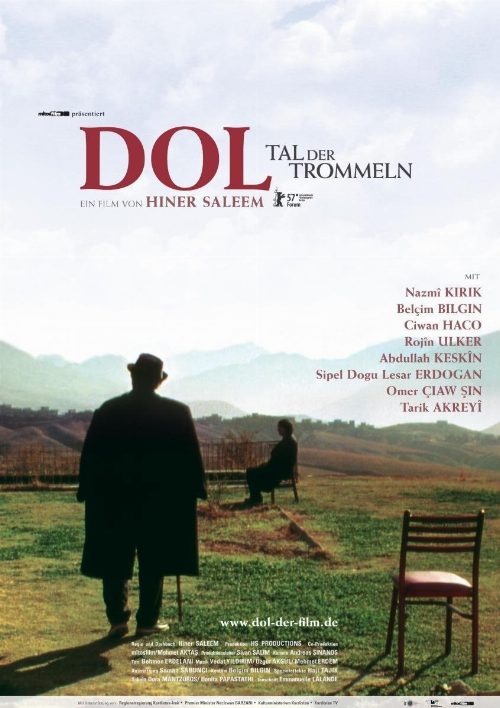
About Dol: The Valley of Tambourines
On his wedding day, a Kurdish man must flee through Turkish, then Iraqi and eventually Iranian Kurdistan.
The rhythmic pulse of a ceremonial drum often signals celebration, but in the 2007 drama Dol The Valley of Tambourines, that same instrument becomes a haunting metaphor for a journey defined by displacement and the fragility of peace. Set against the stark, sprawling landscapes of the Kurdish regions, the film follows a young man whose path to matrimonial bliss is violently intercepted, forcing him into a desperate odyssey across volatile borders. Rather than focusing solely on the mechanics of his escape, the narrative prioritizes the internal toll of a life lived in constant motion, stripping away the romanticism usually associated with wedding-day narratives to expose the raw nerves of a populace caught between shifting geopolitical tides.
This production offers a poignant look at Kurdish cinema, an industry that frequently utilizes film as a bridge between fractured communities and the global stage. Much like the recent wave of regional Indian cinema that emphasizes hyper-local cultural truths to resonate with international audiences, Dol The Valley of Tambourines finds its strength in the specificity of its environment. It captures the tension of the Turkish, Iraqi, and Iranian borderlands not through grand spectacle, but through the quiet, suffocating anxiety of a protagonist stripped of his agency. For viewers who appreciate slow-burn dramas that value atmosphere and sociological inquiry over high-octane pacing, the film serves as a vital piece of historical and cultural documentation. It sits comfortably alongside other seminal works of Middle Eastern auteur cinema that prioritize the human experience within a landscape of perpetual instability.
The ensemble cast, featuring performances by Dariush and Sivan Selim, anchors the film in a grounded, gritty reality that avoids melodramatic pitfalls. Their portrayals reflect a deep understanding of the weariness inherent in their characters, lending the film an authenticity that feels both intimate and expansive. The directing choices lean into the harsh beauty of the terrain, using the environment itself as an antagonist that mirrors the social and political barriers the hero must navigate. This is a film for the discerning cinephile who values storytelling that functions as a mirror to real-world struggles, inviting the audience to consider the cost of belonging when the map of one's homeland is constantly being redrawn. It remains a notable entry for those looking to explore the depth and stylistic ambition of Kurdish filmmaking during a pivotal era for the region's artistic expression.