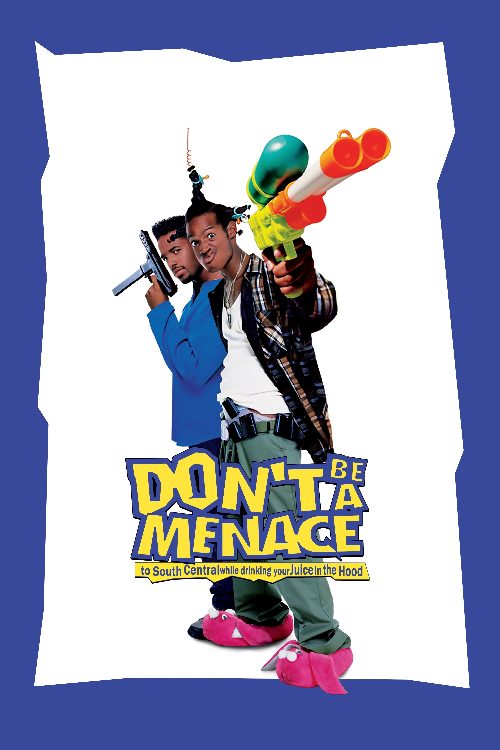
Don't Be a Menace to South Central While Drinking Your Juice in the Hood(1996)
About Don't Be a Menace to South Central While Drinking Your Juice in the Hood
When Ashtray moves to South Central L.A. to live with his father (who appears to be the same age he is) and grandmother (who likes to talk tough and smoke reefer), he falls in with his gang-banging cousin Loc Dog, who along with the requisite pistols and Uzi carries a thermo-nuclear warhead for self-defense. Will Ashtray be able to keep living the straight life?
Satire often functions as a mirror, and few films from the mid-nineties captured the cultural zeitgeist of urban cinema quite like this chaotic, irreverent send-up. While the landscape of American independent film in 1996 was heavily influenced by gritty dramas depicting life in Los Angeles, this project took a sharp turn into absurdity, dismantling the tropes of the hood film genre with surgical precision. By juxtaposing the earnest tone of serious social commentary with slapstick humor and bizarre character dynamics, the movie offers a unique viewing experience that feels like a time capsule of nineties pop culture. It remains a essential watch for those who appreciate meta-commentary, as it constantly acknowledges the cinematic conventions it is simultaneously imitating and mocking.
The narrative centers on a young man navigating his new environment, but the true strength of the film lies in its supporting ensemble. From the gun-toting cousin who carries an unthinkable arsenal to the grandmother who defies every stereotype of maternal authority, the performances are dialed up to eleven. The humor is relentless and frequently pushes boundaries, characteristic of the era and the specific comedic sensibilities of the Wayans family, who were instrumental in shaping this production. For viewers familiar with the serious dramas that dominated the nineties, the film acts as a cathartic release, transforming familiar archetypes into punchlines. It serves as a reminder that even the most sobering depictions of reality can be transformed into a playground for farce when placed in the right hands.
In the context of global cinema, where the blend of crime and comedy has become a staple of regional industries—from the high-octane action comedies of the Telugu film scene to the dark, stylized thrillers emerging from the Malayalam industry—this film occupies a distinct niche. It is a precursor to the wave of parody films that would later become a global phenomenon. Audiences who enjoy fast-paced dialogue, culturally specific references, and a disregard for narrative restraint will find much to admire here. By choosing to prioritize laughter over moralizing, the filmmakers managed to craft a legacy that persists decades later. It is a quintessential piece of nineties nostalgia that rewards those who are well-versed in the cinematic language of the period, offering a frantic, hilarious, and unapologetic look at a very specific moment in American film history.
Cast(65)