

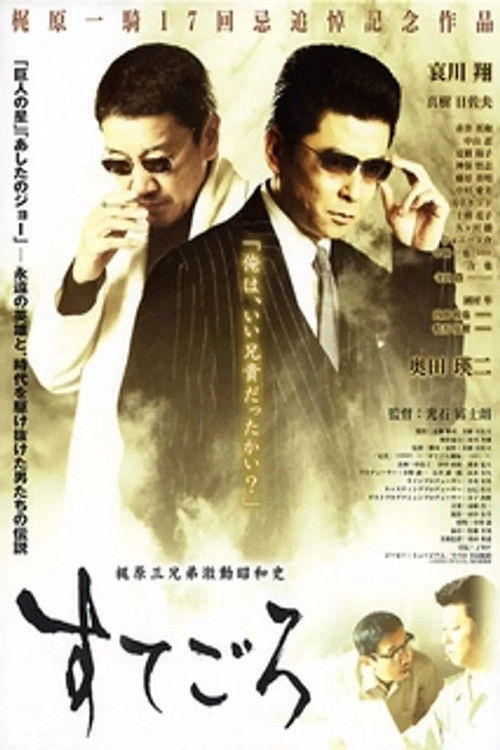
Sutegoro: The Three Kajiwara Brothers' Turbulent Showa History(2003)
About Sutegoro: The Three Kajiwara Brothers' Turbulent Showa History
The story of Asaki (Eiji Okuda) and his younger brother Shinji (Sho Aikawa). The elder brother has established himself as an author of sports manga. The younger brother engages in vigorous bare-knuckle brawls with local yakuza and well-known brawlers. The distance between them grows little by little, and the younger brother struggles in the shadow of his elder brother's light. Strong enemies and incidents appear one after another.
Fujiro Mitsuishi captures the volatile atmosphere of the Showa era through a compelling narrative that pits creative ambition against raw, unfiltered violence. Sutegoro serves as a fascinating character study that explores the divergent paths of two siblings, highlighting the immense psychological toll of living in the shadow of a celebrated public figure. While the elder brother carves out a legacy in the world of sports literature, his younger counterpart finds himself embroiled in the visceral, dangerous realities of underground street fighting. This stark contrast provides a unique lens through which to examine the social hierarchies and shifting cultural landscapes of twentieth-century Japan, offering a gritty perspective that feels both intimate and expansive in scope.
The film stands out by grounding its dramatic tension in the fractured bond between the central pair, played by Eiji Okuda and Show Aikawa. Their performances anchor the story as it navigates themes of identity, fraternal rivalry, and the pursuit of legitimacy in a society that often favors intellect over brute strength. For audiences familiar with the intense character-driven dramas often seen in the best of modern Indian cinema, such as the gritty realism found in recent Tamil or Malayalam crime sagas, this Japanese feature offers a similar blend of high-stakes conflict and deep emotional resonance. It is a work that prioritizes the internal struggle of its protagonist as much as the external skirmishes he faces against formidable adversaries.
Viewers who appreciate slow-burning period pieces that prioritize character development over mere spectacle will find much to admire here. The narrative avoids easy resolutions, instead choosing to delve into the complex repercussions of the brothers' choices and the inevitability of their drifting lives. By focusing on the friction between literary success and the volatile underworld, the director creates a portrait of a fractured family unit that feels universally relatable despite its specific historical setting. It is an essential watch for those interested in the darker corners of Japanese genre filmmaking, serving as a reminder that the most impactful battles are often those fought within one's own family. This production remains a notable entry for cinephiles who enjoy exploring how different regional industries handle the transition between generations and the weight of legacy.



