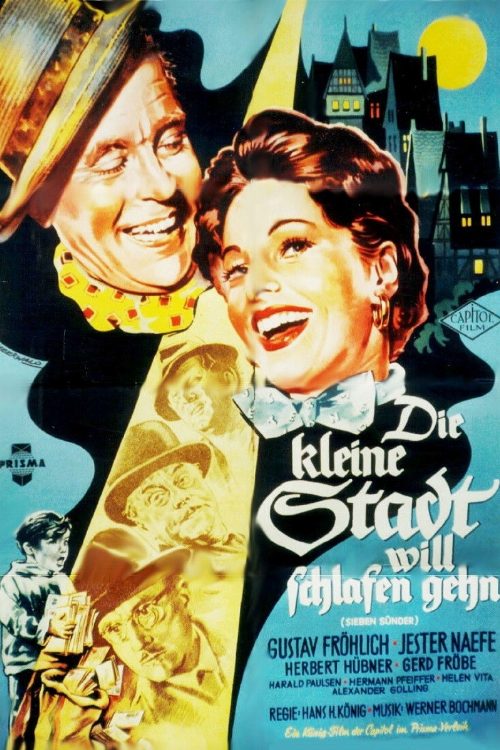
About The Little Town will go to Sleep
In a small town a bag with delicate letters disappears. Many of the residents are worried about their written messages. A clever sculptor uses the opportunity to play a prank.
Hans H. Konig takes a whimsical look at the fragility of human secrets in his 1954 comedy The Little Town will go to Sleep. Set against the backdrop of a quaint, close-knit community, the narrative centers on the sudden vanishing of a satchel containing personal correspondence. While the premise might sound like the setup for a high-stakes mystery, the film opts for a lighter, more satirical tone that explores how the mere threat of exposure can unravel the composure of upright citizens. By focusing on the collective anxiety of the townspeople, the director highlights the absurdity of gossip and the often inflated value we place on the private words we commit to paper.
The film distinguishes itself through its sharp character studies, particularly the role played by the local sculptor. Rather than acting as a traditional protagonist, he functions as a catalyst for chaos, orchestrating a series of misunderstandings that force the town to confront its own hypocrisies. This brand of gentle, situational humor feels remarkably relevant even today, echoing the themes found in modern regional Indian cinema where small-town dynamics often serve as a mirror for broader societal neuroses. Much like the ensemble dramas seen in Malayalam or Marathi industries that rely on witty dialogue and organic interplay between neighbors, this movie thrives on the chemistry of its cast, including Alexander Golling and Gerda Maurus, whose performances ground the escalating absurdity in relatable human behavior.
Audiences who appreciate vintage European cinema with a penchant for dry wit and social commentary will find much to admire here. The storytelling avoids the heavy-handed moralizing common in mid-century morality tales, preferring instead to let the humor emerge from the panic of the residents. It is a perfect watch for those who enjoy character-driven comedies that prioritize charm and clever plotting over grand spectacle. The film remains an insightful look at the tension between public reputation and private reality, serving as a reminder that in a small enough pond, the smallest ripple of a lost letter can turn into a tidal wave of comedic repercussions. By keeping the stakes intimate and the wit sharp, the production manages to capture a timeless slice of life that feels both nostalgic and refreshingly observant of the human condition.
Cast(13)