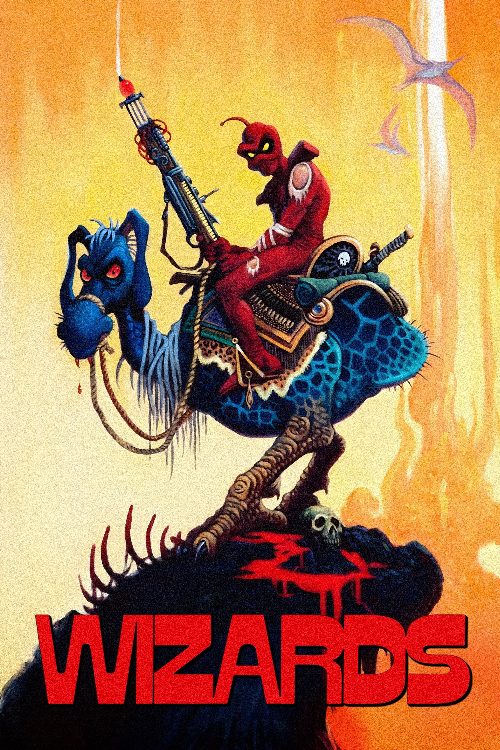
About Wizards
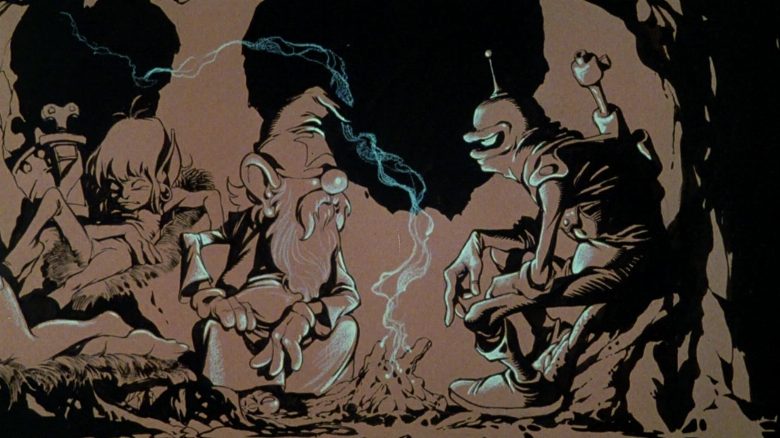
After the death of his mother, evil mutant wizard Blackwolf discovers long-lost military technologies. Full of ego and ambition, Blackwolf claims his mother's throne, assembles an army, and sets out to brainwash and conquer Earth. Meanwhile, Blackwolf's gentle twin brother, the bearded sage Avatar, calls upon his own magical abilities to foil Blackwolf's plans for world domination — even if it means eliminating his own flesh and blood.
Ralph Bakshi has long occupied a singular position in animation history, and Wizards serves as perhaps the most potent example of his willingness to drag the medium into dark, adult-oriented territory. Departing from the polished, family-friendly aesthetic that dominated the era, this 1977 feature presents a post-apocalyptic landscape where the remnants of humanity have splintered into distinct factions defined by technology and mysticism. The narrative centers on a jagged rivalry between two brothers, one representing the decaying remnants of magical tradition and the other embracing the destructive potential of forgotten industrial warfare. While many animated features of the seventies relied on whimsy, this project operates with a gritty, subversive energy that feels closer to the counterculture movements of the time than to standard fairy tales.
The film stands out for its unorthodox visual language, which blends hand-drawn characters with archival footage of historical conflict. This juxtaposition serves as a commentary on the cyclical nature of human aggression, grounding its fantasy premise in a sobering reality. For audiences familiar with the high-concept storytelling often found in contemporary Indian cinema, where mythological struggles are frequently modernized to address current social anxieties, Wizards offers a parallel experience. It treats its internal lore with a seriousness that defies the expectation of cartoons being strictly for children. The aesthetic is abrasive and intentionally unrefined, mirroring the chaotic world it depicts, which has earned it a dedicated status among viewers who appreciate animation as a vehicle for mature, philosophical inquiry.
Those who gravitate toward speculative fiction that avoids neat moral binaries will likely find this journey compelling. It is not a polished epic but rather a raw, visionary experiment that prioritizes atmosphere and thematic weight over traditional narrative pacing. Fans of experimental genre work will appreciate how Bakshi utilizes the medium to explore the tension between progress and preservation. By focusing on the ideological chasm between the two leads, the story forces the audience to consider whether the cost of peace is worth the loss of innovation. It remains a fascinating relic of seventies creativity, appealing specifically to cinephiles who seek out works that challenge the boundaries of what animation can achieve as a serious narrative form. Whether viewed as a cautionary fable or a stylistic benchmark, this title remains an essential entry point for anyone interested in the grittier, unconventional roots of modern fantasy cinema.
Cast(22)












Crew
Producer
Supervising Sound Editor
Animation Director
Editor
Visual Development
Animation Manager
Director of Photography
Original Music Composer
Similar Films