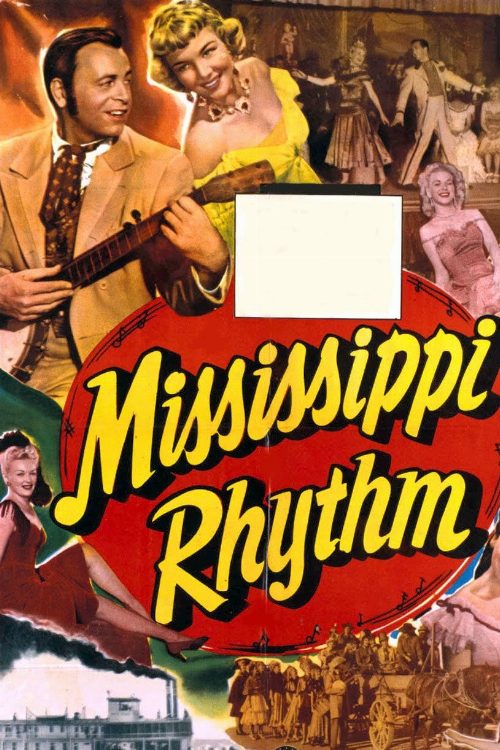
About Mississippi Rhythm
On board a riverboat bound for Creek City, singer Jimmie Davis, who is going to become half-owner of a land development company willed to him by his uncle, shares a cabin with traveling salesman Dixie Dalrymple. After Dixie invites Jimmie to perform in a concert he is putting on for the other passengers, Jimmie is persuaded to participate in a crooked card game run by Judge Homer Kenworthy and his associates. However, with Dixie's intervention, Jimmie wins handsomely, then accuses the gamblers of trying to cheat him.
Navigating the intersection of dusty frontier aesthetics and the harmonious allure of musical performance, Mississippi Rhythm stands as a charming curiosity from the late nineteen forties. While contemporary Indian cinema audiences often look for high-octane emotional arcs in their musical dramas, this American Western utilizes the riverboat setting to craft a unique rhythm of its own. Unlike the sprawling epics that currently dominate the pan-Indian landscape, this film leans into a more intimate, character-driven structure. It captures a specific moment in Hollywood history where the grit of the American West was softened by melodic interludes, creating a tonal balance that feels surprisingly modern in its desire to entertain through multiple genres simultaneously.
The narrative centers on a protagonist who finds himself caught between the inheritance of a land development empire and the unpredictable nature of riverboat gambling. Director Derwin Abrahams constructs a scenario where the stakes are elevated by the presence of a sharp-tongued salesman and a group of predatory card players. For viewers who appreciate the tight, focused storytelling found in classic suspense, the film offers a masterclass in tension built within confined spaces. The dynamic between the primary leads, Lyle Talbot and Joel Marston, provides a grounding element that prevents the musical segments from feeling disconnected from the rising stakes of the plot. It is a testament to the era's efficiency that so much conflict can be distilled into a single journey across the water.
This production is particularly well-suited for cinephiles who track the evolution of the genre film, as it serves as a bridge between the traditional outlaw tales of the early sound era and the more sophisticated, character-led dramas that followed. In the current global climate, where audiences are increasingly hungry for films that blend regional flavor with universal themes of greed and integrity, this vintage feature provides a fascinating look at the roots of such storytelling. It does not attempt to reinvent the wheel, but rather spins it with a distinct stylistic grace that remains engaging over seventy years later. Those who enjoy the rhythmic pacing of a well-executed plot twist will find much to admire here, as the film expertly maneuvers its cast through a series of escalating confrontations that rely as much on quick wits as they do on the luck of the draw.
Cast(12)