About The Art of Violin
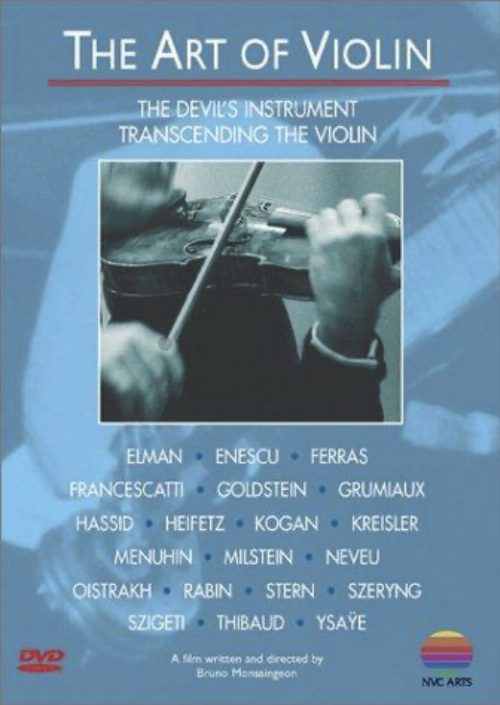
A film written and directed by Bruno Monsaingeon. Drawing on archival performance footage and interviews, The Art of Violin evokes the vast panorama of the world of the violin in the 20th century and its most outstanding performers. It is hard to express the explosions of joy occasioned by the discovery of long sought-out but undreamed-of archives, such as some silent - and later resynchronised - film footage, or the few brief moments of Chausson's Poeme played by Ginette Neveu, the silent yet moving (in every sense of the word)images of Kreisler and Ysaye, the awe of a young Menuhin, the superb single camera shot of David Oistrakh performing the cadenza from Shostakovich's First Concerto. Contributions from Ivry Gitlis, Ida Haendel, Hilary Hahn, Laurent Korcia, Yehudi Menuhin, Itzhak Perlman, and Mstislav Rostropovich, Produced by Pierre-Olivier Bardet & Stephen Wright.
When we look at the evolution of musical documentation, Bruno Monsaingeon stands as a titan of the genre, and his work on The Art of Violin remains a definitive masterclass in preserving sonic history. While the Indian film industry often celebrates the grandeur of orchestration in its own musical traditions, this documentary offers a compelling look at the Western classical canon, focusing on the sheer visceral intimacy of the violin. By weaving together rare, long-lost footage with insightful reflections from the greatest virtuosos of the century, Monsaingeon moves beyond the typical biography. He transforms the screen into a sanctuary for the instrument, capturing the specific, frantic energy of performers who turned the violin into an extension of their own nervous systems.
This film serves as a vital bridge between the historical pioneers of the stage and the modern audience. For viewers accustomed to the high-energy musical sequences found in contemporary Tamil or Hindi cinema, the deliberate and meditative pace of this documentary provides a fascinating contrast. It is not merely a collection of performances, but an exploration of the discipline, sacrifice, and technical genius required to master such a demanding craft. Whether it is the silent, haunting movements of early 20th-century masters or the articulate commentary from icons like Itzhak Perlman and Hilary Hahn, the film demands a level of focus that is increasingly rare in today’s fast-paced streaming landscape. It is essential viewing for anyone who appreciates the intersection of human history and artistic perfection.
Monsaingeon has built a career on his ability to humanize legends, stripping away the myth to reveal the fragile, hardworking artists beneath. In this project, he succeeds by letting the music dictate the narrative rhythm, allowing the archives to speak with a clarity that feels remarkably present. For those who find joy in the technical intricacies of sound or the emotional weight of a well-played concerto, the documentary offers an unparalleled experience. It is a testament to the idea that true art transcends the boundaries of geography and language, resonating as deeply with a global audience today as it did upon its initial release. By highlighting the lineage of violin performance, the film provides a roadmap for understanding how tradition is passed down, preserved, and eventually reinvented by each successive generation of masters.