About Aladin
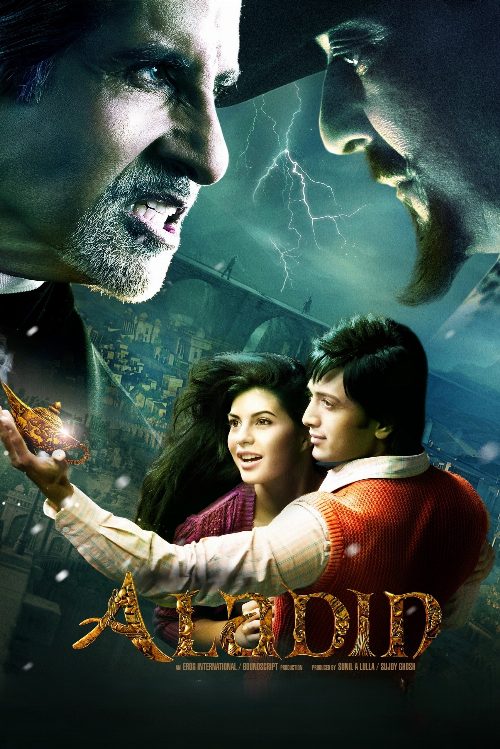
Based in the municipality of Khwaish, abused by his classmates, Aladin Chatterjee, who was orphaned when his parents, Arun and Riya, died in an accident in Siachen Valley, lived with his paternal grandfather until the later's passing. Now alone, grown up, studying in Khwaish University, and still being abused by fellow-college mates, he finds himself smitten by the lovely US Exchange Student, Jasmine. Unable to express his feelings for her, he rubs a lamp that was gifted to him on his birthday, which summons a genie named Genius. He gets 3 wishes, but wastes 2 of them, but on the 3rd one he insists that Genius assist him to win Jasmine's heart without any magical tricks. Hilarious chaos result when everything seems to fail while an immortal and deadly entity, Ringmaster, and his hordes, prepares to confront Genius and Aladin so that he can acquire more magical powers with the help of the lamp on the day of the sighting of a rare comet and the truth behind the death of Aladin's parents.
Stepping into the fantastical landscape of Sujoy Ghosh’s 2009 ambitious project, one finds a daring attempt to reimagine a classic Arabian Nights fable through a distinctly contemporary urban lens. This Hindi feature transports the legendary tale of a magic lamp and its supernatural inhabitant to the fictional town of Khwaish, where a socially isolated college student struggles to navigate the complexities of modern youth culture and unrequited affection. By blending high-concept adventure with the emotional vulnerability of a coming-of-age story, the film functions as a bridge between traditional folklore and the rapid modernization of Hindi cinema during that decade. It serves as a visual spectacle that leans heavily into early computer-generated imagery to create a heightened reality, marking a departure from the gritty realism that would later define the director’s acclaimed thriller filmography.
The core of the narrative hinges on the unconventional dynamic between the meek protagonist, portrayed by Riteish Deshmukh, and the flamboyant, unpredictable genie brought to life by Amitabh Bachchan. Their partnership provides the comedic heartbeat of the movie, offering a lighthearted contrast to the looming threat posed by the antagonist played by Sanjay Dutt. For audiences who enjoy large-scale popcorn entertainment that prioritizes whimsical world-building over grounded storytelling, the film offers a unique experience. It is particularly well-suited for viewers who appreciate the stylistic experimentation common in Bollywood productions of the late 2000s, a period defined by a willingness to push boundaries in genre-bending narratives. The inclusion of Jacqueline Fernandez as the charming student who captures the protagonist’s heart adds a layer of classic romantic tension that ties the fantastical elements to a more relatable human experience.
Beyond its surface appeal, the film captures a specific moment in the evolution of Indian cinema, where filmmakers were increasingly looking toward global fantasy tropes to capture the imaginations of younger, city-dwelling audiences. While the production faced the gargantuan task of balancing heavy special effects with an intimate character arc, its commitment to a bold, colorful aesthetic remains noteworthy. It stands as a testament to the industry’s ongoing fascination with adapting timeless myths into local settings. Those looking for a departure from standard melodramas will find this journey into a world of magical interventions and cosmic confrontations to be a fascinating time capsule of a bold creative swing in mainstream Hindi entertainment.