About Hari Puttar
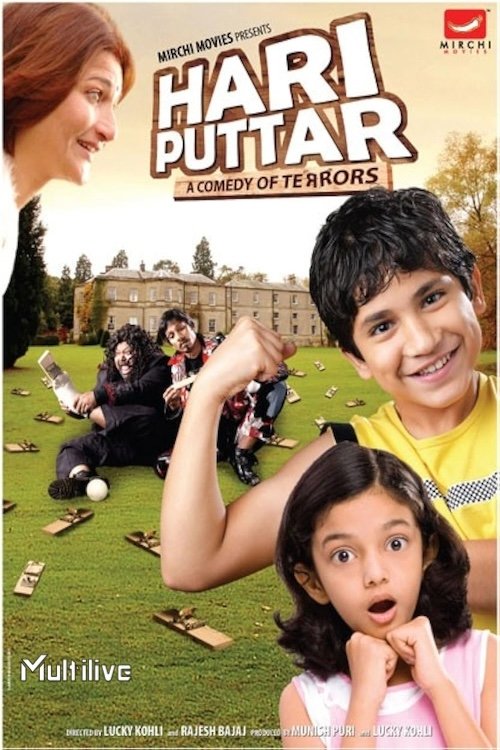
Hariprasad Dhoonca lives with his mom, Sangeeta; dad, Amul; and brother, Rocky in London, England; has a room to himself and plenty of space to play. His privacy will be invaded by the arrival of his aunt, Santosh, his uncle, DK, as well as three cousins and their friends. He will be asked to relocate to another room, while he will be temporarily occupied by his female cousins and their friends. Unhappy with his arrangement; picked upon by his older brother and cousins, he desperately prays to Bhagwan Shri Hanuman for everyone's disappearance. The next morning, he will be delighted to find that his wish has apparently come true - and the only person left in the house is his cousin, Tuk Tuk. While both rejoice with the extra space and freedom from adult supervision - their joy will soon turn to horror and fear when two burglars break into the house to steal a computer chip that belongs to Hariprasad's dad.
The landscape of Indian family cinema in the mid-2000s was defined by a curious blend of traditional values and a burgeoning fascination with Western tropes, a trend perfectly encapsulated by the 2008 release Hari Puttar. Directed by Rajesh Bajaj, the film positions itself as a lighthearted caper that leans heavily into the fish-out-of-water dynamic. Set against the backdrop of an affluent London household, the narrative centers on a young boy whose domestic life is upended by an influx of visiting relatives. By weaving together the innocence of childhood imagination with the high-stakes tension of a home invasion, the film attempts to carve out a niche that appeals to both younger audiences and adults looking for a nostalgic, slapstick-heavy diversion.
What sets this project apart is its blatant adoption of a premise that mirrors classic Hollywood family comedies, specifically those centered on children defending their homes from bumbling intruders. The cultural context here is particularly fascinating, as it reflects a moment when Hindi cinema was increasingly experimenting with international settings to capture the attention of a global diaspora. The cast, featuring seasoned performers like Lillete Dubey, Vijay Raaz, and Saurabh Shukla, provides a layer of seasoned talent that grounds the more chaotic, cartoonish elements of the plot. Their presence ensures that even when the narrative pivots into absurdity, there is a sense of professional commitment that keeps the viewing experience engaging for those who appreciate the broader, theatrical style of the era.
Viewers who enjoy lighthearted, high-energy entertainment that prioritizes physical comedy and whimsical scenarios will likely find much to appreciate here. It is a film that does not demand deep intellectual rigor but instead offers a playful exploration of how a child might react when the safety of their sanctuary is suddenly challenged. For fans of the ensemble-heavy, family-centric dramas that dominated Bollywood during this period, Hari Puttar serves as a unique time capsule. It captures a specific transitional phase in Hindi filmmaking where the industry was eager to bridge the gap between regional sensibilities and the universal allure of the home-defense genre. Ultimately, it remains a curiosity for those interested in the diverse experiments of the late 2000s, showcasing a bold attempt to repackage familiar archetypes through an Indian lens.