
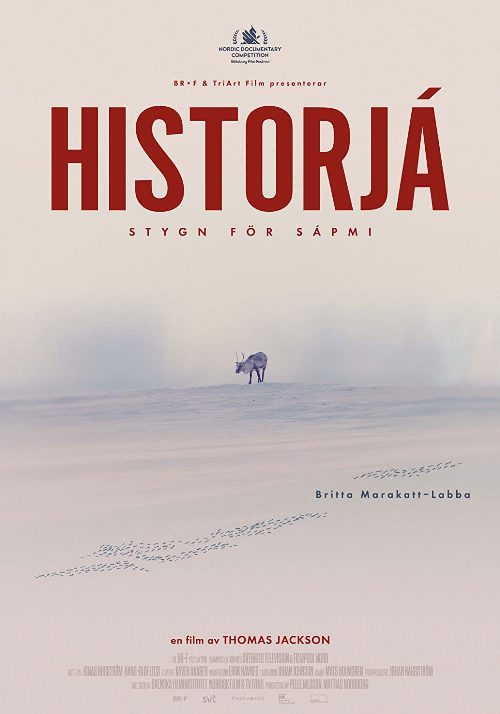
Historjá – Stitches for Sapmí(2022)
About Historjá – Stitches for Sapmí
The large-scale textile artwork “Historjá” by Marakatt-Labba made a huge breakthrough when it was shown at documenta 14 in Kassel. The embroidery, depicting motifs from Sámi history, is also the starting point of Thomas Jackson’s documentary, which tells us about Sámi culture, whose history has been marked by a struggle against the majority population. The struggle has concerned the right to land and way of life, but also underlying this are two views of mankind and its relationship to nature. In Historjá – Stitches for Sapmí, historical events and mythological images are woven together with how climate change threatens contemporary reindeer herding and thus the existence of Sámi culture.
Artistic expression often serves as a vital bridge between ancestral memory and the urgent environmental crises of our modern era. In Historja Stitches for Sapmi, director Thomas Jackson crafts a meditative exploration of the Sami people, utilizing the intricate textile creations of Britta Marakatt-Labba as a visual anchor. While audiences familiar with the vibrant, narrative-heavy documentary traditions of Indian regional cinema might expect a fast-paced investigative style, this film opts for a poetic, observational approach. It elevates the act of embroidery into a form of historical record-keeping, allowing the needlework to narrate a long-standing resistance against cultural erasure and land encroachment in the Arctic north.
The film functions as both an intimate portrait of an artist and a broader commentary on the delicate balance between humanity and the natural world. By focusing on the Sami struggle for autonomy and the preservation of their reindeer-herding traditions, Jackson highlights a universal tension that resonates deeply with global audiences concerned about indigenous rights and climate change. The narrative skillfully avoids becoming a dry history lesson, instead weaving together mythological symbolism with the harsh realities of a changing landscape. For viewers who appreciate cinema that functions as a tapestry of visual art and sociopolitical advocacy, this documentary provides a profound window into a way of life that is currently fighting for its very survival against encroaching industrial and environmental threats.
This work stands out as a significant contribution to the documentary landscape precisely because it centers the voices of those living at the intersection of tradition and transition. Thomas Jackson demonstrates a keen sensitivity to the Sami perspective, ensuring that the film feels like an act of preservation rather than mere observation. It is an ideal recommendation for those who seek out documentaries that challenge the viewer to think deeply about legacy, heritage, and the ethical implications of our relationship with the earth. Whether you are drawn to the aesthetic beauty of the textile work or the gravity of the political themes, the film offers a compelling, visually rich experience that lingers long after the credits roll. It captures a fragile moment in time, reminding us that every stitch in the fabric of a culture represents a choice to either fade away or continue the long, arduous process of storytelling for future generations.