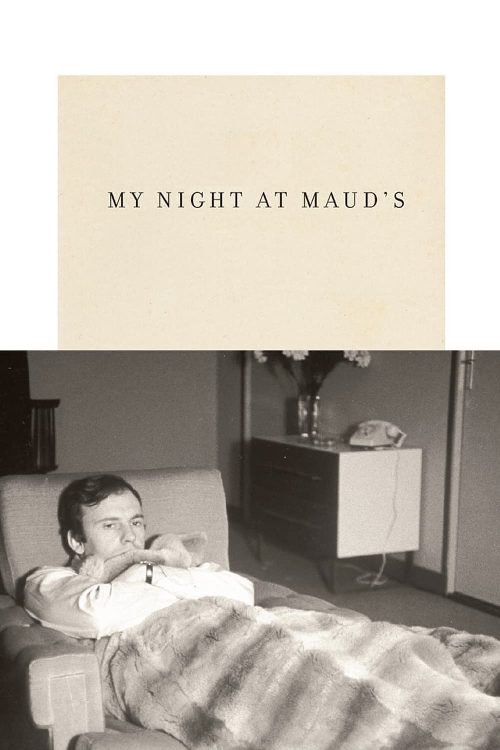
My Night at Maud's(1969)
About My Night at Maud's
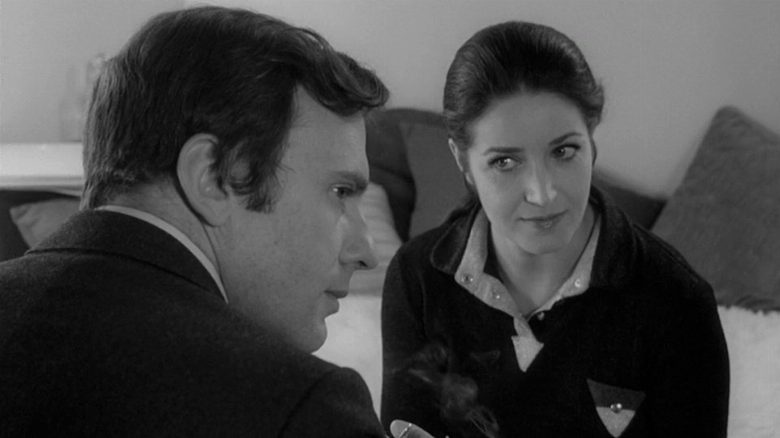
The Catholic Jean-Louis runs into an old friend, the Marxist Vidal, in Clermont-Ferrand around Christmas. Vidal introduces Jean-Louis to the modestly libertine, recently divorced Maud and the three engage in conversation on religion, atheism, love, morality and Blaise Pascal's life and writings on philosophy, faith and mathematics. Jean-Louis ends up spending a night at Maud's. Jean-Louis' Catholic views on marriage, fidelity and obligation make his situation a dilemma, as he has already, at the very beginning of the film, proclaimed his love for a young woman whom, however, he has never yet spoken to.
The intellectual landscape of French New Wave cinema is often defined by its visual restlessness, yet Eric Rohmer takes an entirely different path in My Night at Maud's by turning the camera into an instrument of profound philosophical inquiry. Set against the wintry, snow-dusted backdrop of Clermont-Ferrand, the narrative eschews the typical melodramatic trappings of romance in favor of a high-stakes debate between faith, ethics, and the mathematical probability of human desire. While modern audiences in the vibrant Indian film industries are accustomed to grand emotional spectacles and sweeping musical numbers, this film offers a refreshing, intimate alternative that prioritizes the architecture of human conversation. It serves as a quintessential example of how a screenplay can carry the weight of an entire world simply through the collision of conflicting ideologies.
The film operates as a sophisticated chamber piece, centering on Jean-Louis, a man whose rigid Catholic adherence to moral duty is tested during an unexpected encounter with an old acquaintance and a compelling, free-spirited woman named Maud. Their lengthy discussions regarding the writings of Blaise Pascal provide the intellectual engine of the story, elevating the premise far beyond a standard romantic entanglement. For viewers who appreciate the slow-burn psychological depth found in the works of directors like Mani Ratnam or the nuanced character studies often emerging from the Malayalam industry, Rohmer provides a masterclass in tension. The film is not concerned with external action but rather the internal landscape of a man struggling to reconcile his rigid, predetermined ideals with the chaotic, unpredictable reality of romantic attraction.
Ultimately, My Night at Maud's stands as an essential watch for those who find beauty in the precision of language and the complexity of moral ambiguity. It is a film for the thinkers, those who enjoy dissecting the motivations of protagonists who are often their own worst enemies. By stripping away the artifice of traditional genre storytelling, Rohmer forces his audience to confront the difficult intersection of belief and impulse. Whether one is a seasoned connoisseur of global art-house cinema or a curious newcomer looking to understand the foundations of European auteurism, this piece remains a remarkably sharp observation on why we choose the lives we lead. It proves that the most intense drama often occurs not in the heat of a conflict, but in the quiet, lingering hours of a conversation that changes everything.
Cast(9)