About Next Door
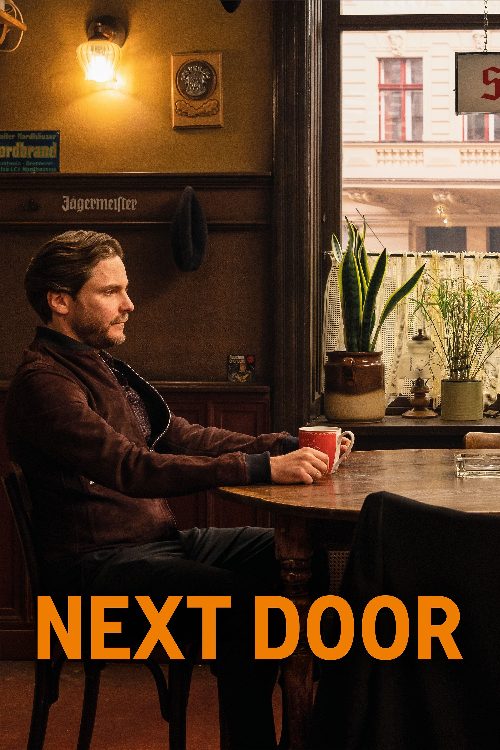
Berlin, the Prenzlauer Berg district. Daniel is a movie star accustomed to success. His loft apartment is stylish and so is his wife, and the nanny has the children under control. Everything is tip-top, bilingual and ready for him to jet off to an audition in London where a role in an American superhero film awaits the celebrated German-Spanish actor. Popping into the local bar on the corner, he finds Bruno sitting there. As transpires by the minute, Bruno has been waiting for this moment for a long time. And so this eternally overlooked man – one of reunification's losers and a victim of the gentrification of what was once East Berlin – takes his revenge. With Daniel as his target...
The intersection of privilege and resentment serves as the volatile foundation for the German dramedy Next Door. Set against the backdrop of a rapidly gentrifying Berlin, the film subverts the traditional celebrity profile by trapping a high-profile actor in an increasingly claustrophobic interrogation initiated by a mysterious stranger at a neighborhood tavern. While Indian cinema has frequently explored the friction between the wealthy elite and the common man through the lens of social melodrama, this film adopts a sharper, more cynical European sensibility that prioritizes psychological tension over grand spectacle. It effectively captures the post-reunification hangover of East Berlin, transforming a simple pub encounter into a biting critique of class disparity and the hollow nature of modern fame.
For viewers who appreciate the recent shift toward intimate, dialogue-driven thrillers seen in industries like Malayalam or Kannada cinema, this project offers a similarly grounded experience. The narrative functions as a two-man power struggle, relying heavily on the chemistry and escalating hostility between the lead performers. It is an ideal watch for those who enjoy character studies where the subtext is far more dangerous than the spoken word. By eschewing typical action tropes in favor of a verbal sparring match, the film forces the audience to question their own allegiances, constantly shifting the moral high ground as the protagonist’s carefully constructed life begins to unravel under the weight of his neighbor’s long-simmering bitterness.
Daniel Bruhl, who makes his directorial debut here, brings a meta-textual layer to the proceedings by casting himself as an actor whose life mirrors his own professional trajectory. This self-referential approach adds a distinct flavor of authenticity that elevates the material beyond a standard revenge drama. The screenplay dissects the arrogance of the metropolitan upper class with surgical precision, leaving little room for sentimentality. As the protagonist waits for his flight to a high-budget international project, the reality of his past and the resentment of those left behind in the wake of urban transformation collide with brutal efficiency. It is a sharp, compact piece of filmmaking that serves as a reminder that even the most polished lives are built on foundations that can be easily dismantled by someone who has nothing left to lose.
Cast(14)