About Dekh Kabira Roya
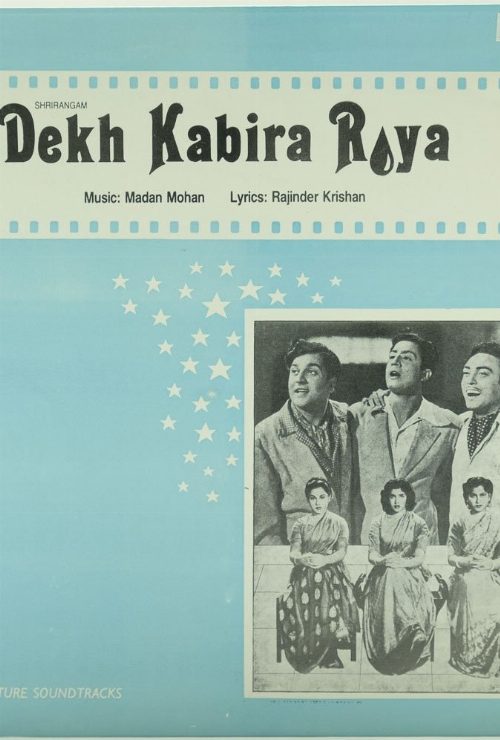
A romance masquerading as a debate on art. A painter, a writer and a singer meet three women, each of whom loves one of the art forms they practise. Unfortunately, they are mismatched. The ensuing misunderstandings are resolved only after their respective soul mates have been discovered and their marriages arranged. This is one the the last independent films by A. Chakrabarty, formerly of Bombay Talkies and the man who discovered Dilip Kumar in his first film, Jwar Bhata (1944).
Dekh Kabira Roya stands as a sophisticated relic of mid-century Hindi cinema, capturing an era where the silver screen was as much a classroom for social ethics as it was a vehicle for entertainment. Directed by Amiya Chakrabarty, a visionary who played a pivotal role in the early trajectory of the Bombay Talkies legacy, this feature serves as a fascinating intersection of romantic comedy and intellectual discourse. By focusing on a trio of creative men—a painter, a writer, and a musician—the film masterfully dissects the tensions between artistic passion and the practicalities of domestic life. The narrative thrives on the irony of mismatched affections, presenting a series of humorous entanglements that arise when personal temperament fails to align with professional inspiration. It is a refreshing departure from the era’s more melodramatic offerings, opting instead for a witty exploration of companionship that feels surprisingly ahead of its time.
Within the landscape of 1950s Bollywood, this project distinguishes itself by treating the creative process as a central character rather than a mere backdrop. The film invites viewers to consider whether shared passions or complementary personalities form the stronger foundation for a lasting partnership. This thematic ambition is bolstered by the presence of a talented ensemble cast including Anoop Kumar and Shubha Khote, who bring a lighthearted charm to the complex web of relationships. For audiences who appreciate the golden age of black-and-white classics, the film offers a sophisticated look at the social conventions of the period, wrapped in a narrative that emphasizes the search for genuine compatibility over traditional matchmaking expectations.
The directorial touch of Amiya Chakrabarty is evident in the film’s balanced pacing and its elegant portrayal of urban life. Having previously been instrumental in shaping the careers of legendary performers, Chakrabarty demonstrates a keen eye for character chemistry here, ensuring that the comedic misunderstandings never overshadow the emotional stakes of the protagonists. This film is an ideal pick for cinephiles who enjoy period pieces that prioritize dialogue and situational irony over spectacle. It captures a specific moment in Indian cultural history where the modernizing world was beginning to clash with long-held marital customs. By weaving together the distinct rhythms of art and romance, the film remains a compelling watch for anyone interested in the foundational storytelling techniques that defined the evolution of the Hindi film industry.