About Uplotneniye
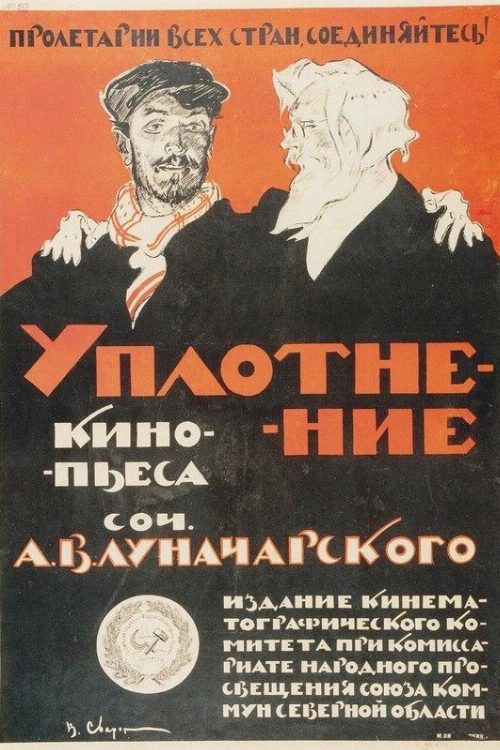
In the process of housing redistribution, a worker and his daughter are relocated from a damp basement to one of the rooms at a professor's spacious flat. Factory workers begin to visit and the number of guests grows and grows; the professor begins to hold widely attended lectures at the workers' club. Romance blossoms between the professor's youngest son and the worker's daughter, and the two decide to marry...
Early Soviet cinema often serves as a fascinating window into a society undergoing a radical shift in domestic structure, and Uplotneniye stands as a pivotal artifact of this transition. Produced in 1918, this film captures the immediate aftermath of the Russian Revolution through a lens that blends lighthearted social comedy with the earnest drama of class integration. Unlike the grand, sweeping epics that would later define the Soviet montage movement, this project focuses on the intimate, often humorous friction caused by the policy of compulsory housing redistribution. By placing a working-class family into the living quarters of an established academic, director Anatoli Dolinov highlights the awkward, sometimes chaotic, but ultimately optimistic attempts to bridge the gap between the intelligentsia and the proletariat. It is a rare glimpse into a moment when the new social order was being negotiated in hallways and kitchens rather than on the battlefield.
For cinephiles who appreciate the evolution of world cinema, this film offers a distinct contrast to the intense regional narratives seen in modern Indian cinema, yet it shares a thematic interest in the collision of different social worlds. Much like how a contemporary Telugu or Malayalam film might use a domestic setting to explore shifting caste or class dynamics, Uplotneniye uses the forced proximity of its characters to drive its narrative engine. The story finds humor in the professor's loss of personal space as his home becomes a hub for factory workers, yet it retains a soft touch in the blossoming romance between the two young leads. It is this balance of ideological subtext and human connection that makes the film an accessible watch for those interested in historical aesthetics, as it avoids the heavy-handed didacticism that would characterize many state-sponsored films in the following decade.
Viewers who enjoy character-driven stories where environment acts as a primary antagonist will find much to admire here. The performances by Dmitry Leshchenko and Ivan Lerskiy ground the whimsical premise in a sense of reality that keeps the viewer engaged despite the century-old production techniques. While the pacing reflects the sensibilities of early silent cinema, the core conflict regarding the loss of privacy and the birth of new societal relationships remains surprisingly relatable. This film is best suited for those who view cinema as a historical document, offering a unique perspective on how artists navigated the complex political climate of 1918. It serves as a testament to the fact that even during the most tumultuous periods of history, the silver screen remained a space for exploring the universal aspirations of love, belonging, and the search for common ground.