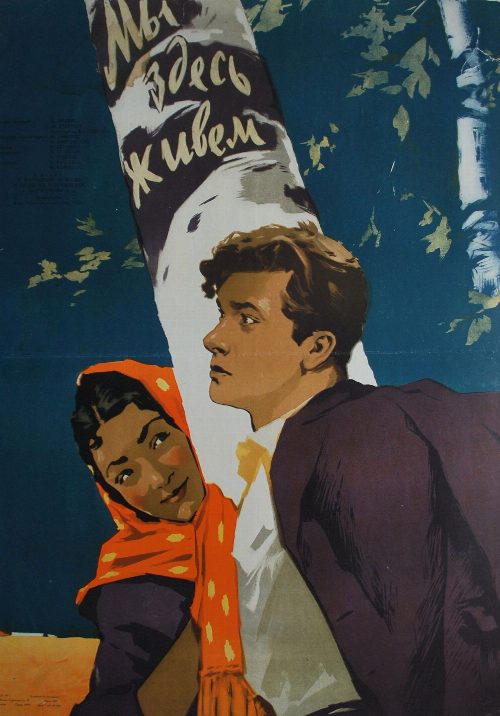
About Here We Live
1954. The first detachment of young virgin lands arrives in the remote Kazakh steppe. The old forester Bulanbai warns the guys about the difficulties, but the youth boldly gets to work. We have to fight not only with the harsh nature, but also with the inertia of the director of the trust of state farms Kuanysh Korkutov. Contrary to his instructions, the director of the Komsomolsky state farm Kudryash prefers to process heavy, but more promising land masses. The secretary of the regional committee Beisov supports Kudryash. Korkunov is being removed from office. Soon a new group of young people arrives at the state farm...
The mid-fifties Soviet cinema landscape often functioned as a canvas for ideological transformation, yet Here We Live manages to capture the raw, visceral spirit of the virgin lands campaign with an unexpected focus on the collision between administrative stubbornness and youthful idealism. Directed by Matvey Volodarskiy, this 1956 drama transports viewers to the vast, unforgiving Kazakh steppe, where the arrival of eager city-bred pioneers serves as the catalyst for a clash of generations. While many films of this era leaned heavily into purely propagandistic messaging, the narrative here finds its strength in the friction between those tethered to outdated bureaucratic protocols and the restless energy of those determined to reshape the landscape. The tension is not merely environmental, but deeply institutional, pitting the rigid directives of local authorities against the forward-thinking vision of those on the ground.
For audiences familiar with the regional cinema of the former Soviet republics, the film serves as a fascinating historical artifact that highlights the cross-cultural dynamics between Moscow-led initiatives and the local Kazakh environment. The presence of actors like Shakhan Musin and Zamzagul Sharipova brings an essential layer of regional authenticity to a story that might otherwise have felt detached from the realities of the steppe. The film is positioned as a character-driven study of resilience, where the vast, empty horizons act as both a daunting adversary and a blank slate for the protagonists to define their own futures. It is a work that captures a specific moment when the promise of progress was measured in soil turned and state farms established, reflecting the broader mid-century obsession with modernization and human willpower.
Viewers who enjoy classic dramas that prioritize human conflict over spectacle will likely find this period piece compelling, particularly those interested in the evolving storytelling techniques of mid-fifties Soviet-era production. It is a film for the history enthusiast and the student of global cinema who seeks to understand the social pressures that shaped agricultural expansion during the Cold War. By focusing on the struggle against the inertia of figures like the local trust director, the film manages to elevate a routine story of land reclamation into a nuanced exploration of leadership and the cost of innovation. It stands as a testament to the era's belief in the power of youth to challenge the status quo, even when that challenge requires navigating a labyrinth of institutional resistance in one of the most remote corners of the world.