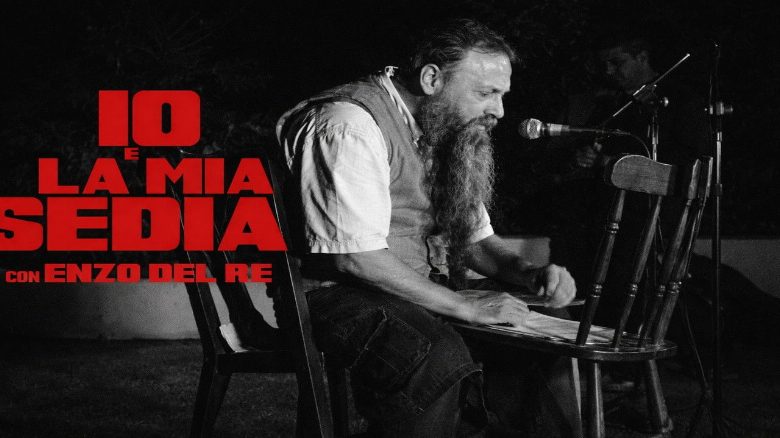

About My Chair and I
Shut away in his home, at the top of a very steep staircase of thirty steps, Enzo Del Re manages—though not without effort—to bend the world to himself rather than be bent by it. A Puglian storyteller of extraordinary evocative power, Enzo Del Re is also a musician of remarkable innovative ability in musical production and in the use of humble, makeshift instruments. An icon of Apulian music, little known yet overwhelming once discovered. Through his story, three important decades of the Italian cultural scene are retraced, from Nanni Ricordi to Dario Fo, all the way to Nuova Scena and the Circoli Ottobre. Then darkness, and today the rediscovery of Del Re at the May Day concert in 2010 alongside Vinicio Capossela. Today he claims that he “did not fight for a pension, but for the revolution.”
Few cinematic portraits capture the intersection of isolation and artistic defiance with as much intimacy as Angelo Amoroso D Aragona achieves in his 2010 documentary My Chair and I. By focusing on the reclusive yet magnetic figure of Enzo Del Re, the filmmaker invites audiences into a domestic sanctuary perched atop a daunting flight of stairs, transforming a humble living space into a theater of memory and radical politics. The film serves as a vital bridge between the forgotten corners of Italian folk history and the broader cultural shifts that defined the nation in the latter half of the twentieth century. Rather than a standard biographical recitation, the documentary functions as a contemplative study of how a singular creative spirit can choose to withdraw from the mainstream while simultaneously exerting a profound influence on the evolution of musical expression.
The project holds particular resonance for cinephiles who appreciate the intersection of musicology and social history, offering a rare glimpse into a career built on the repurposing of ordinary objects into instruments of protest. Del Re emerges as a figure of immense integrity, whose refusal to conform to institutional expectations mirrors the broader counterculture movements of his era. For fans of regional storytelling, this film acts as a crucial document, elevating a local legend from the Puglia region into a universal symbol of artistic autonomy. It effectively captures the spirit of the May Day concert revival, providing necessary context for those who may have encountered his work only through contemporary collaborations.
Viewers who enjoy character-driven narratives that eschew flashy editing in favor of raw, authentic conversation will find this journey deeply rewarding. The film is perfectly suited for those interested in the genealogy of Italian performance art, as it touches upon the legacy of figures like Dario Fo and the influence of the Nuova Scena collective. By anchoring the narrative in the physical reality of Del Re’s home, the director emphasizes the power of persistence over the allure of fame. Ultimately, this work stands as a testament to the idea that true revolutionary work is rarely found in the pursuit of security, but rather in the unwavering commitment to one’s own creative truth, even when the world outside has long since moved on. It is a quiet, poignant exploration of a life lived on one’s own terms, proving that even from a single chair, a person can challenge the status quo.
Cast(9)


Crew
Director
Similar Films