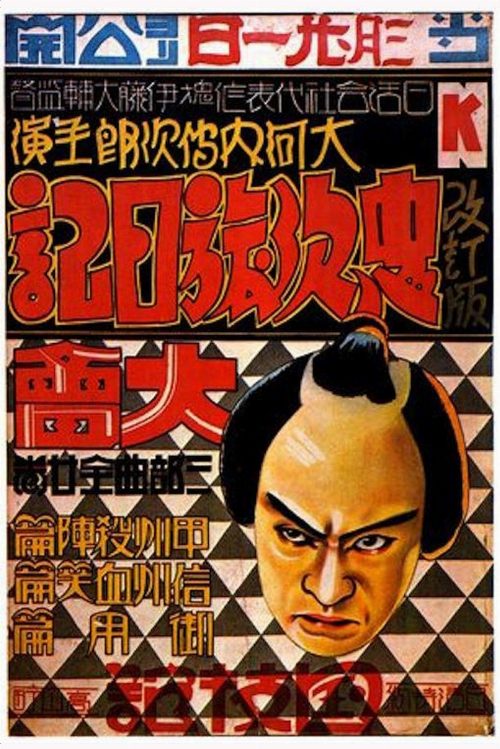
Chuji's Travel Diary: Story of Bloody Shinshu(1927)
About Chuji's Travel Diary: Story of Bloody Shinshu
A Diary of Chuji's Travels is a silent Japanese jidaigeki made in 1927 starring Denjirō Ōkōchi and directed by Daisuke Itō. It was originally released in three parts, all of which were long thought to be lost until portions of the second part and much of the third part were discovered and restored in 1991. Since the film had once been voted in a 1959 Kinema Junpō poll as the best Japanese film of all time, its discovery was significant. At the time of its release, Itō was the leader of a new style of samurai films that featured outlaw heroes and fast-cut sword fighting scenes.
Few artifacts of early world cinema carry the weight of mythic reconstruction quite like the surviving fragments of Chuji's Travel Diary: Story of Bloody Shinshu. Directed by the visionary Daisuke Ito during a pivotal era for Japanese jidaigeki, this silent epic redefined how audiences perceived the wandering ronin archetype. By moving away from the stiff, theatrical traditions of its predecessors, Ito injected a kinetic energy into the genre through rapid-fire editing and a focus on the gritty, outlaw nature of his protagonist. For students of Indian cinema, who are well-acquainted with the evolution of the folk hero or the righteous rebel in regional industries like Telugu or Tamil film, this work serves as an essential ancestor to the high-octane action motifs we celebrate today. It captures a shift from stage-bound performance to a cinematic language that prioritizes movement and visceral tension.
The legacy of this production is as compelling as the narrative itself, having spent decades as a ghost of film history before partial recovery in the late twentieth century. Seeing Denjiro Okochi embody the titular wanderer provides a rare glimpse into the star power of the nineteen-twenties, where physical presence and sharp, rhythmic swordplay were paramount. The film operates as a quintessential road odyssey, tracing a path of moral ambiguity and societal friction that remains relatable to any viewer interested in the roots of the outlaw protagonist. It is not merely a historical curiosity but a masterclass in visual storytelling, proving that even in its fragmented state, the work retains a haunting, atmospheric power that explains why it was once canonized as the pinnacle of its national output.
Modern cinephiles who appreciate the intersection of stylized violence and character-driven drama will find much to admire here. The film is positioned as a foundational text for those who enjoy the kinetic choreography of contemporary action epics, providing a stark, monochromatic blueprint for the hero who operates outside the boundaries of the law. Because the narrative unfolds with a focus on the internal turmoil of its lead, it avoids the trap of becoming a simple period piece, instead resonating as a timeless exploration of individualism and sacrifice. Whether you are a scholar of global film history or simply a fan of the evolution of the action hero, this restored treasure offers a fascinating look at how a director’s innovative eye can influence the trajectory of popular culture for nearly a century.