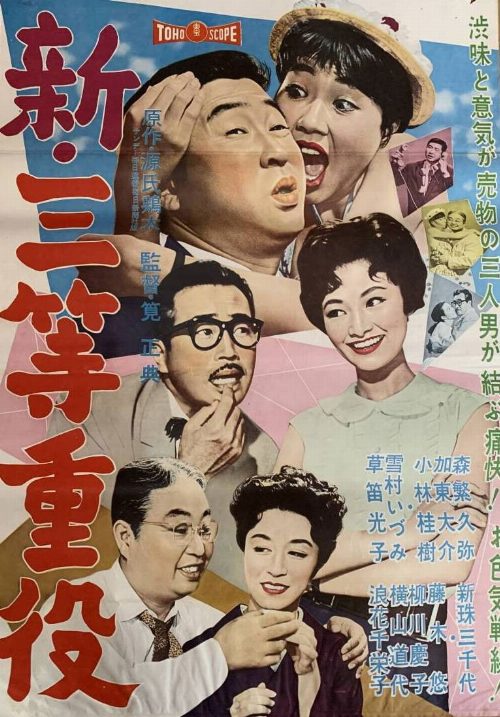
About New Third-Class Executive
At an Osaka electronics company, power struggles, corporate schemes, and personal agendas collide when the boss is away. As tensions rise around a meddling heiress and a collapsing business deal, one quiet employee steps up to set things right.
The frantic rhythm of mid-century corporate life serves as the backdrop for New Third-Class Executive, a sharp Japanese comedy that remains surprisingly relevant to the modern professional landscape. Set within the bustling corridors of an electronics firm in Osaka, the narrative captures the chaotic fallout that ensues when leadership vacates the office. While many films of the late fifties focused on grand historical epics or heavy social dramas, this production leans into the satirical potential of the workplace, highlighting the petty grievances and ambitious power plays that emerge when the hierarchy is temporarily suspended. It captures a specific moment in post-war Japan where the salaryman culture was beginning to solidify into the rigid, high-pressure system that would define the nation for decades to come.
The film is anchored by a compelling performance from Hisaya Morishige, an actor whose ability to balance comedic timing with grounded sincerity makes him the perfect vessel for a story about an unassuming office worker forced into a position of unexpected influence. Alongside him, Keiju Kobayashi provides a foil that emphasizes the friction between genuine diligence and the calculated maneuvering of those seeking to climb the corporate ladder at any cost. For viewers who enjoy the dry wit of classic workplace comedies or the observational humor found in contemporary Indian office dramas, this film offers a fascinating window into how human nature remains consistent regardless of the decade or the continent. It moves beyond simple slapstick, choosing instead to explore the underlying anxiety of being a cog in a machine that is threatening to break down.
Fans of international cinema will find this a refreshing entry point into the golden age of Japanese studio filmmaking, particularly for those interested in the social commentary hidden behind lighthearted premises. It is positioned as a witty exploration of loyalty and integrity in an environment designed to reward ruthlessness. Those who appreciate the character-driven storytelling found in regional Indian hits will likely resonate with the way the film balances its comedic set pieces with genuine stakes regarding the protagonist’s future. By focusing on the quiet resilience of an ordinary employee amidst a sea of opportunists, the movie provides a timeless lesson on the value of quiet competence. It stands as a testament to the fact that the most interesting battles are often fought not in grand arenas, but within the fluorescent-lit cubicles where our daily lives are spent.
Cast(15)