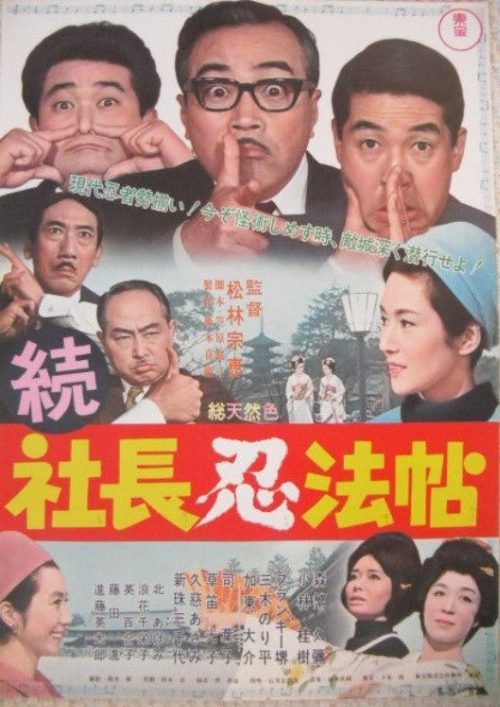
About President's Ninja Trick Book Part II
Iwato Construction secures a major project in Hokkaido and promotes a key employee, but chaos follows—personal conflicts, missed deals, and a lost hotel contract. Redemption comes when they restore a fire-damaged department store, earning overdue payment and a morale boost.
The 1965 Japanese feature Presidents Ninja Trick Book Part II captures a fascinating moment in the post-war industrial landscape, blending the rigid corporate hierarchy of mid-century Japan with the zany, high-energy sensibilities of a classic farce. Directed by Shu Matsubayashi, the film functions as a mirror to the frantic economic expansion of the era, where the stakes of a construction firm were often treated with the same dramatic intensity as a battlefield maneuver. By centering the narrative on the internal machinations of Iwato Construction and their desperate scramble to secure a foothold in the Hokkaido market, the story transforms mundane business logistics into a series of comedic blunders and personal rivalries that feel surprisingly relatable to modern audiences familiar with the high-pressure workplace dynamics seen in contemporary Indian corporate satires.
What makes this entry distinctive is its willingness to pivot between lighthearted slapstick and the genuine anxieties of professional insecurity. While the industry is often dominated by grand epics or gritty realism, this film opts for a lighter touch, focusing on the human cost of missed opportunities and the frantic pursuit of recovery. Fans of regional Indian cinema, particularly those who enjoy the ensemble-driven chaos found in Malayalam workplace comedies or the fast-paced scriptwriting of Telugu urban dramas, will likely appreciate the interplay between the cast members, including Norihei Miki and Yoko Tsukasa. Their performances elevate the material, ensuring that the stakes remain grounded in character development rather than just the mechanics of the plot.
The film is positioned as an ideal watch for viewers who enjoy vintage international cinema that does not take itself too seriously while still offering a glimpse into the social fabric of its time. It serves as a reminder that the struggle to balance ambition with integrity is a universal language, transcending borders and decades. Whether it is through the lens of a fire-damaged department store requiring urgent restoration or the delicate management of personal conflicts within an office, the movie highlights the resilience required to maintain dignity in the face of inevitable corporate turbulence. For those interested in the evolution of the comedy-drama genre, this piece stands as a charming artifact that proves even the most bureaucratic business dealings can be fertile ground for genuine entertainment when handled with the right amount of wit and heart.
Cast(24)